
In many construction projects, especially high-rise buildings, the speed of floor cycle construction directly affects the overall project schedule.
A delay of one day per floor may not seem significant at the beginning. However, for a 30-story building, saving one day on each floor cycle can shorten the entire project timeline by nearly one month.
Traditionally, contractors have relied on plywood formwork for concrete slab construction. However, problems such as water absorption, deformation, heavy handling, and difficult stripping often slow down the construction process.
Today, more contractors are turning to hollow plastic formwork as an alternative solution because it can improve work efficiency while reducing repeated material costs.
1. Why Traditional Wood Formwork Slows Down Construction
Wood formwork has been widely used because it is easily available and relatively low-cost. However, its performance decreases quickly under repeated construction conditions.
Water absorption causes deformation
Wood is a natural material that absorbs moisture from concrete.
During concrete pouring:
- The plywood absorbs water
- The panel may expand or warp
- The surface accuracy decreases
- Additional adjustment work is required before reuse
According to research from organizations such as the Forest Products Laboratory, moisture content has a significant impact on wood dimensional stability.
For contractors, this means additional labor time is required to repair, adjust, and replace damaged panels.
Difficult stripping increases labor time
After concrete curing, plywood formwork often sticks to the concrete surface.
Workers usually need:
- hammers
- crowbars
- additional manpower
to remove the panels.
The process may also leave cement residue on the plywood surface, requiring cleaning before the next use.
This repeated cleaning and repair work creates hidden labor costs.
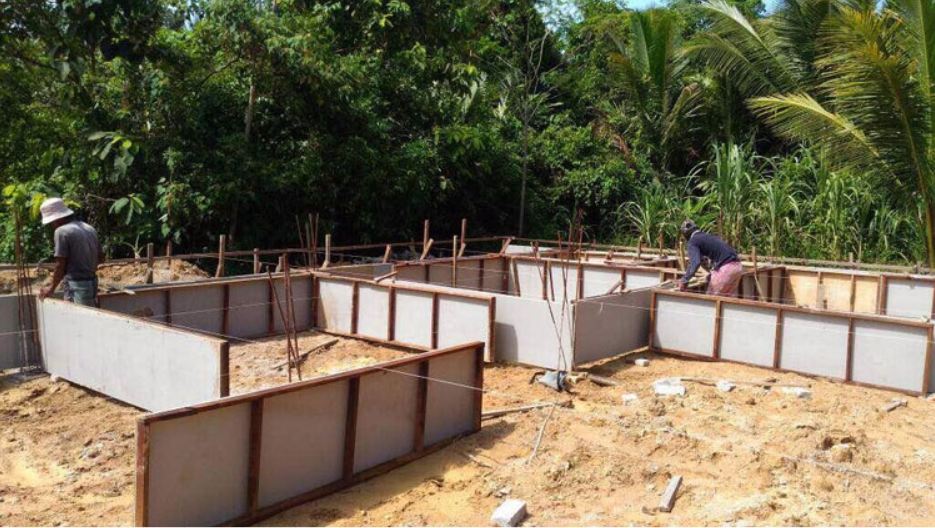
2. How Hollow Plastic Formwork Improves Construction Speed
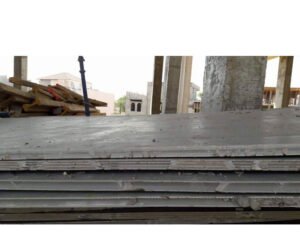
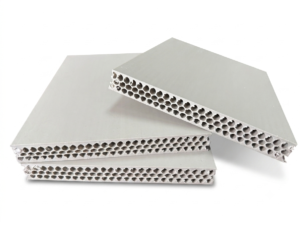
Unlike wood, PP hollow plastic formwork is manufactured from polypropylene material with a smooth, waterproof surface.
You can learn more about our product structure here:
https://pgformwork.com/product/white-hollow-plastic-formworkround-holes/
100% waterproof surface reduces preparation and cleaning time
One of the biggest advantages of plastic formwork is its extremely low water absorption.
After concrete pouring:
- The panel does not swell
- The surface remains stable
- Concrete does not strongly bond to the panel
During stripping, workers can remove panels quickly without excessive force.
After removal, the surface usually only requires simple cleaning before reuse.
Compared with plywood, this reduces downtime between construction cycles.
Lightweight design improves installation efficiency
Weight is another important factor affecting construction speed.
A typical plywood panel becomes heavier after absorbing water during use.
Hollow plastic formwork maintains a stable weight because polypropylene does not absorb moisture.
Benefits include:
- Easier transportation around the site
- Faster installation
- Reduced worker fatigue
- Lower dependence on lifting equipment
For large-scale projects, these small improvements accumulate into significant time savings.
3. Faster Formwork Turnover Creates a Shorter Floor Cycle
The biggest advantage of hollow plastic formwork is not only installation speed, but also faster turnover.
Many modern construction systems use an early stripping method:
- Remove panels after concrete reaches sufficient strength
- Keep supporting props in place
- Transfer panels to the next floor
This allows one set of formwork panels to serve multiple floors during continuous construction.
Compared with traditional plywood systems, reusable plastic formwork can help contractors achieve a faster floor cycle.
Related reading:
https://pgformwork.com/product/white-hollow-plastic-formworkround-holes/
4. Why Contractors Can Reuse Hollow Plastic Formwork 50+ Times
Construction companies do not only consider the purchase price of formwork.
The more important question is:
How much does each use actually cost?
For example:
A plywood panel may be replaced after several uses because of:
- cracking
- deformation
- nail holes
- surface damage
However, high-quality PP plastic formwork has excellent:
- impact resistance
- waterproof performance
- dimensional stability
With proper handling and storage, many plastic formwork systems can achieve 50 or more reuse cycles.
More information:
https://pgformwork.com/product/gray-hollow-plastic-formwork-70-100-uses/
5. Lower Long-Term Cost for Construction Companies
At first glance, plastic formwork may have a higher purchase price than plywood.
However, the real calculation should include:
- purchase frequency
- labor cost
- cleaning time
- replacement cost
- construction delays
The cost per use decreases significantly when the panels are reused many times.
This is why more contractors are evaluating formwork based on lifecycle cost instead of only initial price.
6. Sustainable Construction: Reducing Wood Waste
The construction industry generates millions of tons of waste every year.
According to the United Nations Environment Programme, the building sector has a major impact on global resource consumption and waste generation.
Polypropylene plastic formwork provides a more sustainable alternative because:
- PP is recyclable
- Panels can be reused many times
- Less wood consumption is required
- Construction waste can be reduced
For companies pursuing green building standards, reusable plastic formwork is becoming an increasingly attractive option.
Conclusion: Saving One Day Per Floor Can Change Project Economics
Construction speed is not only about finishing earlier.
One saved day per floor can reduce:
- labor expenses
- equipment rental costs
- project management pressure
- overall construction risk
By combining lightweight design, waterproof performance, and high reusability, hollow plastic formwork provides contractors with a practical way to improve construction efficiency.
For modern construction projects, the question is no longer only:
“How much does the formwork cost?”
The better question is:
“How much value can this formwork create throughout the project lifecycle?”